
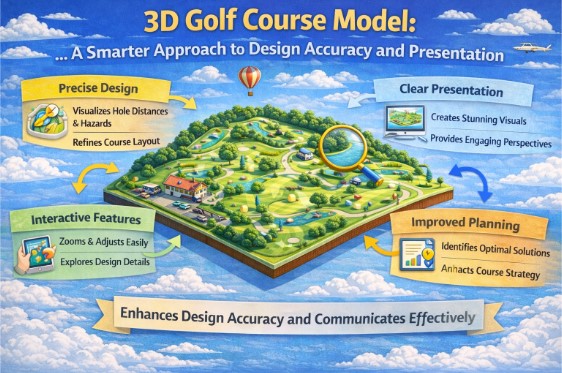
Traditionally, golf-course design is very precise. These smallest changes in elevation, slope, or placement of bunkers sometimes significantly alter that particular hole’s playability.
In modern projects, however, the demand for communication has made it easier for owners, investors, and planning bodies. Hence, the 3D golf course model is a smart and more reliable way to realize the design.
It enables designers to work with real-world terrain logic while presenting ideas in a manner that is easy to understand for all. When developed by the best 3D rendering companies, these models ameliorate the disparity between technical accuracy and clear visual storytelling.
Seeing the Course as It Will Actually Exist
Traditional drawings and 2D layouts demand imagination. A 3D golf course model does away with such guesswork. Designers can view the course from ground level, aerial angles, or actual player perspectives.
Fairways, greens, hazards, and elevation changes all seem just as they would in real life. This realism helps designers assess whether the hole feels balanced, whether those slopes are playable, and whether sight lines are working as they should.
Higher Accuracy in Terrain and Elevation Design
More than for almost any other sport facility, golf courses are shaped by the land. Drainage, contours, and natural elevation directly affect the playability and maintainability of each course.
The 3D modeling of a golf course allows the designer to work with accurate terrain information, thus ensuring that after the grading and shaping, the decisions will really make sense from the very beginning.
This ensures that expensive corrections are minimized after the fact, and it supports designs that embrace rather than fight the natural landscape.
Smarter Design Decisions Through Early Testing
Design problems are easier to cure before construction. With the aid of the 3D model, the designer can try out different line forms, change the slope of the green, move bunkers, or change tee placements very early in the process.
The changes that would have required weeks to visualize in a drawing can be reviewed immediately in a 3D environment. This adaptability engenders better decisions without hindering project timing.
Clear Communication With Non-Technical Stakeholders
Not everybody on a golf course project speaks or understands the language of technical plans. Clarity rather than detail is what most owners, investors, and authorities like to see.
The 3D-course model becomes a universal visual language as all users can see how the course flows, where key features are located, and how the design interacts with the land. Clarity reduces confusion and thus serves to accelerate approvals.
Stronger Presentation for Approvals and Marketing
This applies particularly to high-value landscape projects. A professional-looking and intelligently designed 3D computer representation instills confidence and showcases professionalism. It allows decision-makers to envision the end product, as opposed to interpreting lines and symbols.
Many developers further reuse these models for marketing, member previews, and promotional material purposes. When designed by the best 3D rendering Company, the model functions simultaneously as both a design tool and a presentation aid.
Improved Coordination During Construction
Construction teams can, at times, lose the intent of the design, especially when they rely on drawings. A 3D golf course model will serve as a visual reference throughout the build phase.
It allows contractors to fully appreciate grading intent, the location of features, and transitions between elements, thus removing guesswork during construction.
Supporting Sustainable and Environmental Planning
Today’s golf course projects should manage water, vegetation, and environmental considerations. Among other things, through 3D modeling, designers will understand how water flows, the drainage pattern that occurs, and the natural features at the site before construction.
In this way, informed, sustainable choices are facilitated, and golf courses are made to blend more seamlessly into their environment while complying with the environmental criteria.
Long-Term Value Beyond Initial Design
The 3D golf course model does not lose its value after the design is approved. Instead, its value can be sustained by modification for renovations, future expansions, or course modifications.
This 3D model can also lend support to capstone presentations, collaborative planning discussions, and visual documentation. Hence, it becomes a long-term asset rather than a mere capital expense for a one-off design.
Conclusion
In summary, the 3D golf course model offers a smattering of smarter design, refinement, and presentation of contemporary golf courses. Accuracy, evidence-based decisions, and clarity of thought formation are some of the key advantages of a 3D course.
When these models are developed by the best 3D rendering company, they become even more than visual rendering; they become an essential design tool to ensure golf courses play better, are built better, and present better throughout from concept to completion.